



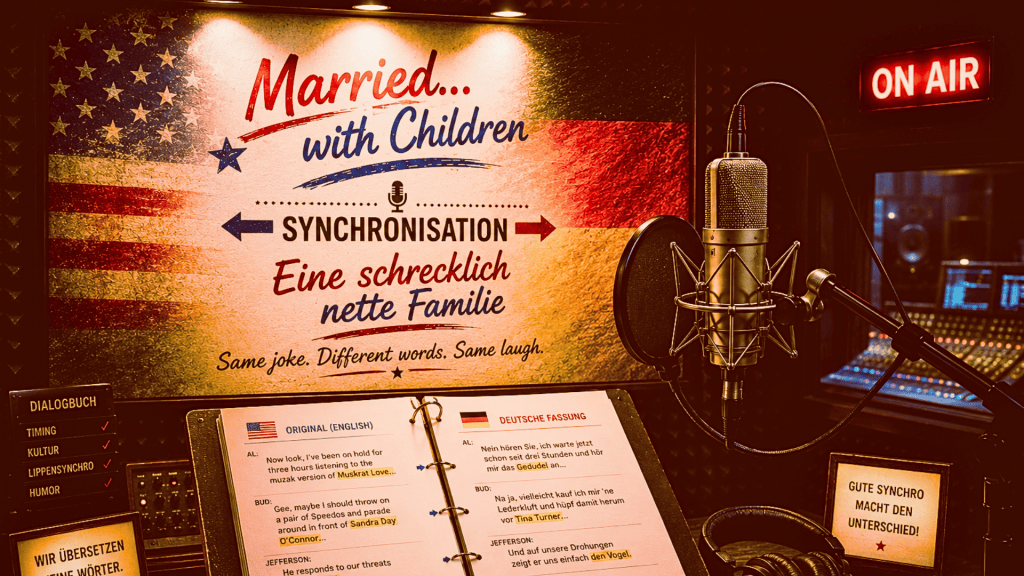
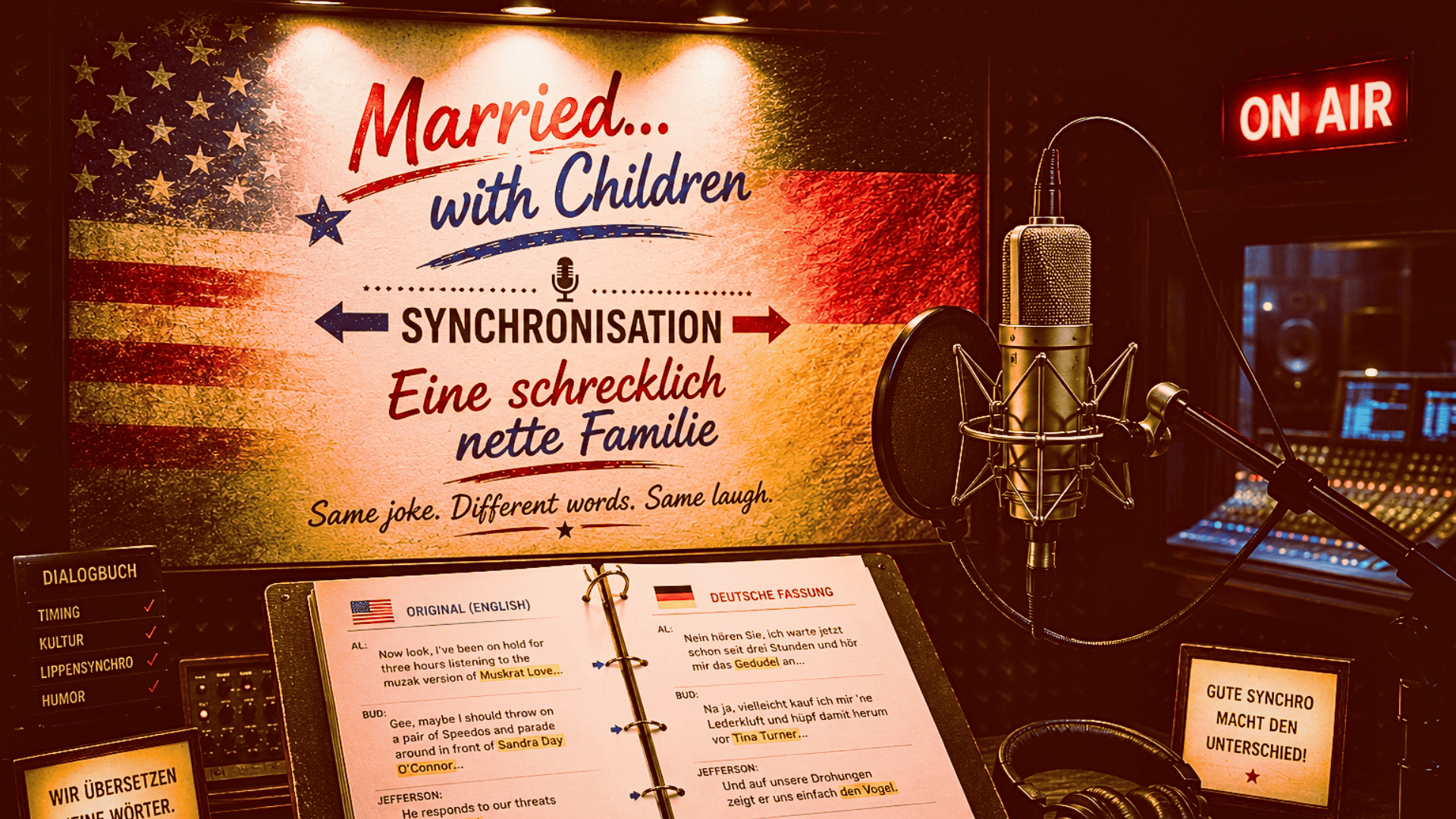
While thinking about all these differences, I came across something fascinating on YouTube: a 1994 TV segment hosted by Hans Meiser featuring several of the German voice actors as well as dubbing director and dialogue writer Hans-Peter Kaufmann.
What struck me most was how much creative work goes into dubbing a show like *Married… with Children*.
According to Kaufmann, his job was not simply to translate the scripts. He would first watch each episode in English and then work through it line by line, trying to find the funniest possible German equivalent. The real challenge was not understanding the words. The challenge was understanding why a joke worked — and then finding a way to make German audiences laugh at the same moment.
The more I listened, the more some of the differences I had noticed while comparing both versions started to make sense.
To illustrate this, let’s stay with a single episode: Season 5, Episode 13, *The Godfather*.
### Example 1: Al and “Muskrat Love”
Early in the episode, Al is stuck on hold while trying to get help from the city. Frustrated after waiting for hours, he complains:
> “Now look, I’ve been on hold for three hours listening to the muzak version of Muskrat Love…No, I voted for Mayor McCheese or whatever his name is…”
For American viewers, the reference was fairly straightforward. *Muskrat Love* was a real pop song, and the joke is that Al has been listening to a bland elevator-music version of it for hours.
The German version became:
> “Nein hören Sie, ich warte jetzt schon seit drei Stunden und hör mir das Gedudel an, was ihr auf die Menschheit loslasst. Nein, ich bin ein Wähler von Bürgermeister McCheese oder wie auch immer der Mann heißt…”
*”Gedudel”* is a slightly humorous German word for mindless or irritating background music that nobody really wants to listen to.
Translated back into English, it would mean something like:
> “that annoying background music.”
The specific American pop culture reference disappears completely, but the joke remains immediately understandable for a German audience.
The words are different, but the punchline remains the same: Al is being driven crazy by annoying music while waiting on the phone.
### Example 2: Bud, Peggy and Sandra Day O’Connor
Later, Peggy tells Bud:
> “You know, all these years we thought that you would be the success in the family. Boy, was I wrong.”
Bud responds:
> “Gee, maybe I should throw on a pair of Speedos and parade around in front of Sandra Day O’Connor. Hey, it might mean a condo by the White House for the family. Would that make you guys proud?”
For many German viewers at the time, Sandra Day O’Connor was probably a far less recognizable reference.
Hans-Peter Kaufmann replaced it with:
> “Na ja, vielleicht kauf ich mir ‘ne Lederkluft und hüpf damit herum vor Tina Turner. Hey, dann bekomm ich vielleicht ein eigenes Haus irgendwo in Europa. Würde euch das vielleicht stolz machen?”
Translated back into English:
> “Maybe I should buy a leather outfit and jump around in front of Tina Turner.”
The image changes completely.The punchline stays exactly the same. Bud is still mocking the idea of gaining success through a powerful celebrity connection. German viewers simply received a version they could instantly relate to.
### Example 3: Marcy, Jefferson and “The Bird”
A little later, Marcy and Jefferson approach Al, who is now acting as the Godfather.
They complain about a disrespectful paperboy.
Marcy says:
> “Oh Al, please help us. The paper boy shows us no respect. We’ve complained, but still he throws our paper in the sprinklers, crushing the flowers we planted with care.”
Then Jefferson adds:
> “He responds to our threats with the bird.”
In American English, *”giving someone the bird”* means making an insulting gesture, most commonly showing the middle finger.
The German version became:
> “Oh Al, bitte hilf uns. Dieser Zeitungsjunge zeigt uns keinen Respekt. Obwohl wir uns beschwert haben, wirft er die Zeitung immer noch in den Rasensprenger und zerstört die Blumen, die wir sorgfältig gepflanzt haben. Und auf unsere Drohungen zeigt er uns einfach den Vogel.”
Interestingly, German has a very similar expression:
> “jemandem den Vogel zeigen”
Literally, it also means:
> “to show someone the bird.”
However, the traditional German gesture and meaning are slightly different. In Germany, it usually refers to tapping your forehead to suggest that someone is crazy. Despite the different meanings behind the expression, both versions manage to be funny.
### Example 4: Fredo vs. Doofi
Near the end of the episode, Bud complains that nobody includes him in the family’s plans anymore.
He says:
> “Well, before we go, I guess what’s bothering me is that no one’s including me in the plans anymore. I mean, I’m not Fredo. Kelly’s Fredo. I’m the smart one.”
For American viewers, the joke is immediately clear.
Fredo Corleone from *The Godfather* is widely remembered as the weaker and less capable brother.
The German version became:
> “Bevor wir gehen. Ich glaube, was mir stinkt ist, dass ich in euren Plänen überhaupt keine Rolle mehr spiele. Ich meine, ich bin nicht Doofi. Kelly ist Doofi. Ich bin der Gebildete.”
Translated back into English:
> “I’m not the dummy. Kelly’s the dummy. I’m the educated one.”
Once again, the cultural reference disappears. The meaning remains exactly the same. The audience still understands that Bud sees himself as the intelligent member of the family.
That was the moment I realized that the German writers were often not translating jokes at all. They were rebuilding them.
Another detail from the Hans Meiser segment stayed with me:
Hans-Peter Kaufmann explained that he did not primarily cast voice actors based on whether their voices matched the original actors. Instead, he looked for performers with the acting skills necessary to recreate what was happening on screen.
That idea suddenly explained a lot to me. Kathrin Ackermann, for example, does not sound exactly like Katey Sagal. Yet despite those differences, she became Peggy Bundy for German audiences. The same is true for Rüdiger Bahr as Al, Claudia Lössl as Kelly, Dominik Auer as Bud and Erik Schumann as Buck. They all became the Bundys for us because their voice acting was exceptional.
And after watching that 1994 segment, I found myself appreciating the German version even more than before. What I ultimately took away from all this was a new appreciation for just how difficult dubbing really is. Especially in a sitcom, simply translating the words is often not enough. The joke has to remain funny, the cultural reference has to make sense, the timing has to work and the dialogue still has to fit the actor’s performance on screen.
Looking at these examples, I realized that Hans-Peter Kaufmann and the German voice actors were not just translating a television show.
**They were recreating it for a completely different audience.**
At the same time, comparing both versions also reminded me how difficult it can sometimes be for a German viewer to fully understand American slang, cultural references and everyday expressions — even after many years of watching the show. And perhaps that is exactly what makes comparing both versions so fascinating.
For many of us who grew up with the show in Germany, the voice actors were never just voices. They became part of the characters themselves…
The Hans Meiser segment that inspired many of the thoughts in this article is still available on YouTube and well worth watching for anyone interested in the German dubbing process:


Leave a Reply
You must be logged in to post a comment.