

This is the episode where the Bundys bury Buck, and the show handles it exactly the way it had handled everything else for nine years: by refusing to get sentimental about it on the surface while letting real feeling leak through underneath. The family and the D’Arcys come home from the funeral, which cost twelve hundred dollars, a figure that reduces Al to tears for reasons that have nothing to do with grief. Peggy warns him to go easy on Kelly, who was closest to the dog, and Al promptly suggests they get rid of Buck’s old things, which sets Kelly off and establishes the half-hour’s shape: everyone processing a loss badly and in their own direction.
The replacement-pet plot runs from there. Jefferson offers a connection, a friend who smuggles in exotic animals alongside less reputable merchandise, and Al’s only requirement is that whatever they end up with be cheap. What arrives is a bird the group oversells as a Venezuelan emerald-crested cockatoo with a hundred and fifty-word vocabulary and a gift for celebrity impressions. Kelly is unmoved, pointing out the obvious, it is not Buck, and the bird’s tenure in the house turns out to be measured in minutes, because Peg’s mother is upstairs and hungry.
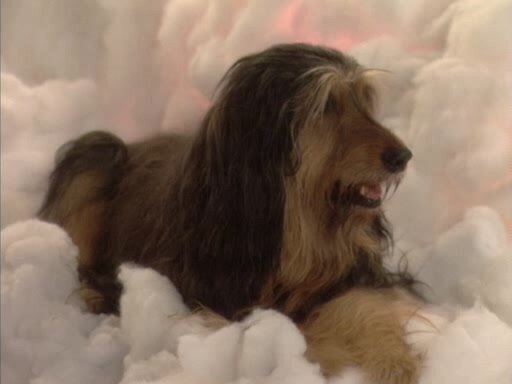
Around the animal business, the episode stages a séance, brings in Don Novello’s Father Guido Sarducci to run it, and gives Buck one last turn as the voice of the household’s conscience before handing the collar to a new dog named Lucky. Twelve-year-old Buck the briard was retired at his trainer’s request; he had reached the upper end of his breed’s life expectancy and was having trouble reading hand signals from across a soundstage. He died the following May, about nine months after this episode was taped, which lends the whole half-hour a weight nobody involved could have intended.
Episode Facts
- Original air date: Sunday, October 1, 1995 on FOX
- Season 10, Episode 3
- Overall episode 214 of the series
- Taped September 1, 1995; production code 10.03
- Written by series co-creator Michael G. Moye, his only script for season ten and his last for the series
- Directed by Gerry Cohen
- The final appearance of Buck Bundy and the first appearance of Lucky Bundy
- The title is one of several the show built on the Requiem construction, following “Requiem for a Dead Barber” and preceding “Requiem for a Chevyweight”
Guest Cast
- Don Novello as Father Guido Sarducci
- Kathleen Freeman as the voice of Peg’s Mom
- Ben Stein as Thomas
- Kevin Schon as the voices of Felix D. Katt and the Mouse Lawyer
- Roger Rose as the voices of Tweety and the Bailiff
Retiring Buck
Buck the dog had been on the show since the pilot, and his retirement was a practical decision rather than a story one. Trainer Steven Ritt asked for it: the briard was twelve, at the long end of a breed that typically lives ten to twelve years, and the distance work the job required, reading hand signals from off-camera across a set, had become difficult for him. The production wrote the departure into the script rather than quietly swapping dogs, which is why the episode is a funeral instead of a recast.
The choice to give Buck a send-off at all is a little out of character for a series that spent a decade puncturing sentiment, and the script manages it by burying the feeling under jokes about money. Al does not cry for the dog; he cries for the invoice. He compares the expense unfavorably to King Tut’s burial arrangements. The grief is real but it is routed entirely through Kelly, who is the only member of the household the show permits to mourn out loud, and even her mourning gets a Shakespeare misquote attached to it.
Michael G. Moye wrote it, which is not incidental. He had stepped down as showrunner after the ninth-season finale and stayed on as a creative consultant, and this was the one script he contributed to season ten before leaving the entertainment business entirely. Handing the co-creator the episode where the original dog is buried reads, in hindsight, like a deliberate piece of bookkeeping, one of the people who built the house closing out one of its oldest fixtures.
Famous Quotes
- Jefferson: “Kelly, have we got the pet for you.” / Marcy: “A bird.” / Al: “Takes one to buy one.” The D’Arcys arrive with a covered birdcage while Al and Kelly are still sorting through replacement options.
- Bud: “This is a genuine Venezuelan emerald-crested cockatoo. He does great celebrity impressions.” / Jefferson: “And he knows over 150 different words.” / Peggy: “That’s got your father beat right there.” The sales pitch, immediately undercut.
- Kelly: “Yeah, but he’s not Buck. Can he roll over and play dead?” / Marcy: “Buck couldn’t do that.” / Al: “Till now.” Al and Bud share a quiet laugh at the back of the room, which is as close as either gets to processing the loss.
- Al: “I’ve got some good news and I’ve got some bad news. The good news is Tweety knew over 150 words. The bad news is that none of them were ‘Please don’t eat me.’” Delivering the fate of Kelly’s replacement bird to the family from the foot of the stairs.
Notes
- Buck the dog died on May 28, 1996, roughly nine months after this episode was taped.
- Father Guido Sarducci, who conducts the séance, is a character Don Novello originated on Saturday Night Live in the late 1970s and has brought back on screen repeatedly over the decades since.
- This is the first episode to put the show’s official website in the closing credits, pointing viewers to the Married… with Children page on Sony’s site.
- An instrumental “Amazing Grace” opens the episode.
- Al’s running comparison between Buck’s funeral costs and King Tut’s burial is historically shaky: Tutankhamun had one wife, believed to have been interred separately.
- In “Kids! Wadaya Gonna Do?” Buck said he expected to live to thirteen. He was around nine at the time, and this episode lands roughly five years later, which would put him at fourteen.
- During Al’s account of what happened to Tweety, Ed O’Neill can be seen gripping the staircase railing and pausing mid-line, visibly working not to laugh.
Leave a Reply
You must be logged in to post a comment.